Introduction
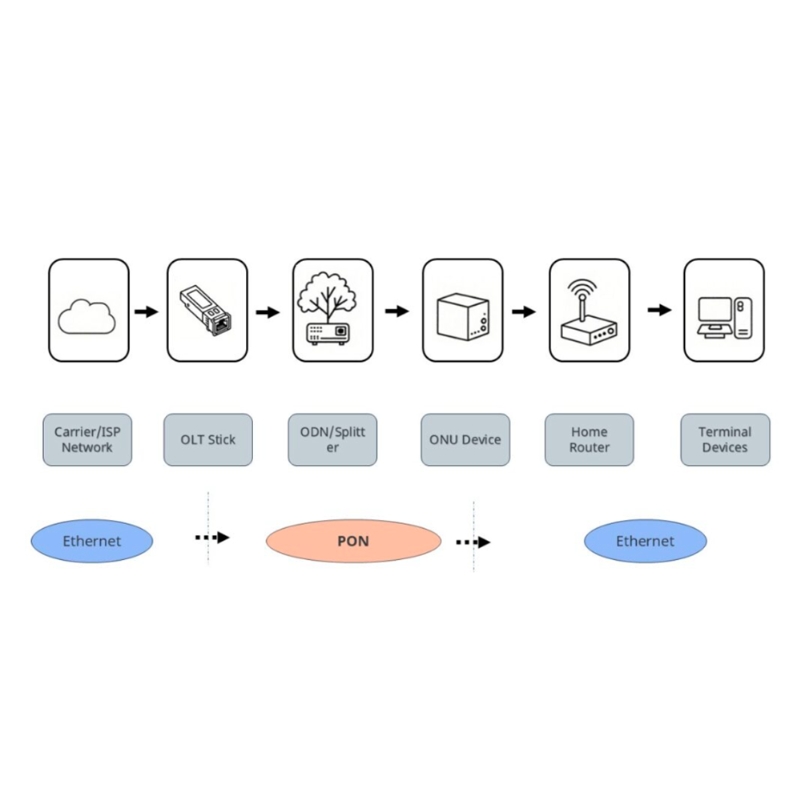
Assume a residential scenario where the PON network spans from the OLT to the ONU. Traffic is distributed through the ODN, and the ONU converts optical signals back into Ethernet, delivering internet access to individual households. In this process, have you considered how power is supplied? Can the commonly used PoE (Power over Ethernet) meet these requirements? What is PoF (Power over Fiber), and does it offer advantages compared to PoE?
This article introduces PoE and PoF, compares their respective advantages and limitations, explains how to choose the option that best fits your requirements, and describes how Asterfusion deploys PON networks.
What Is PoE (Power over Ethernet)
PoE, or Power over Ethernet, is a technology defined by IEEE 802.3af (PoE) and IEEE 802.3at (PoE+). It uses the LLDP protocol for fine-grained power management and delivers both data and power over standard Ethernet twisted-pair cabling. PoE relies on the standard RJ45 interface and is the most widely used power delivery method in modern networks. It is typically used between access switches and endpoint devices.
What Is PoF (Power over Fiber)
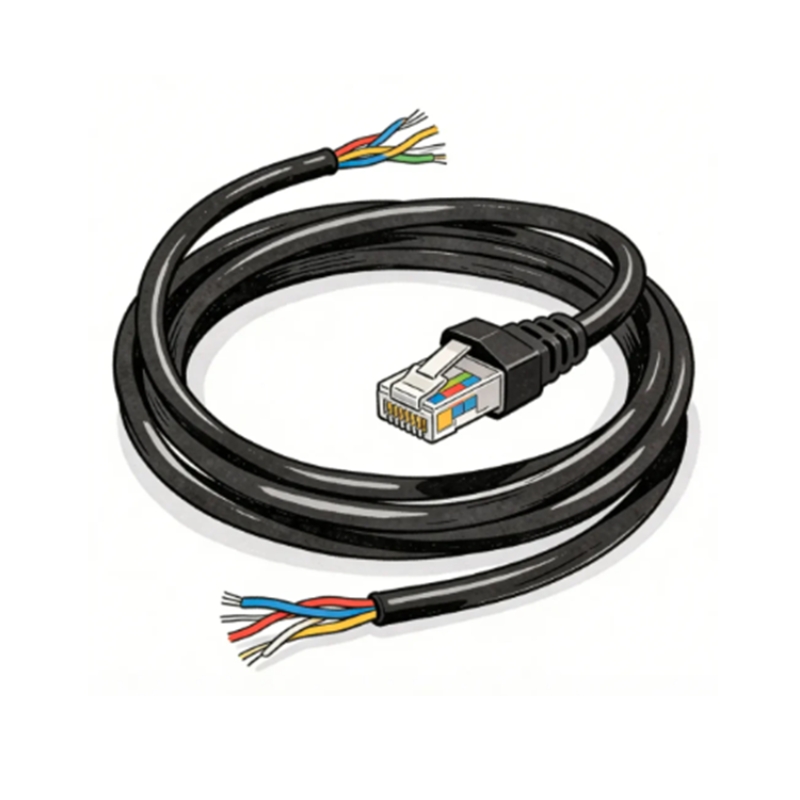
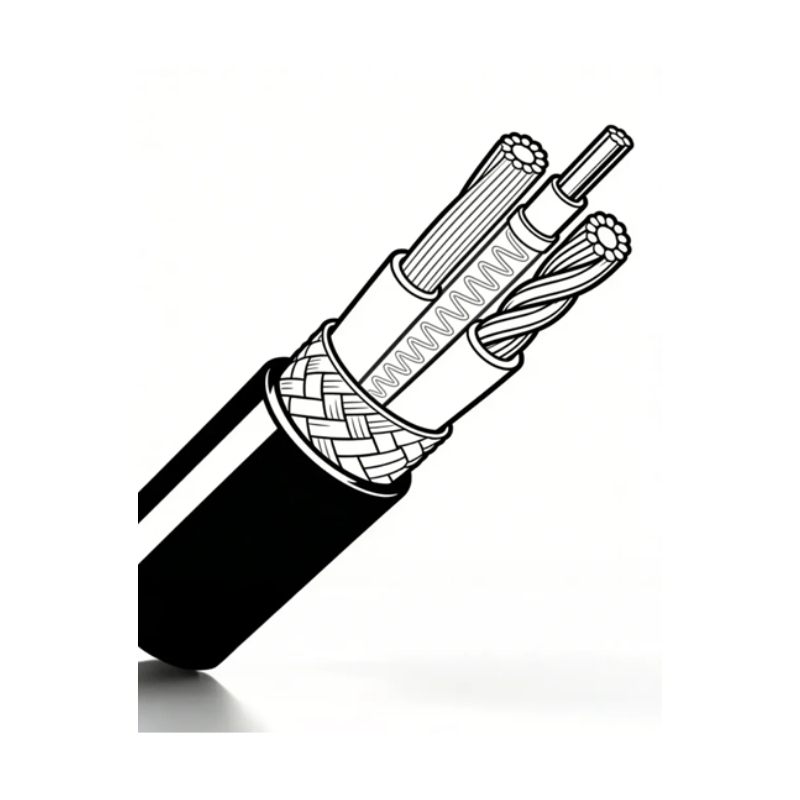
In engineering networks, PoF (Power over Fiber) typically refers to hybrid fiber cabling, where optical fibers and copper conductors are integrated into a single cable.
PoF, power over fiber, was originally used in deep-sea communication systems to supply power to signal repeaters deployed on the seabed at intervals of tens of kilometers. Later, as mobile networks evolved toward 3G and 4G, base stations adopted distributed architecture. The remote radio unit (RRU), responsible for RF processing, was mounted on towers tens of meters high. Deploying optical fiber and power cables separately was complex and costly, which led to the adoption of PoF solutions. As a result, operators now deploy hybrid fiber cabling at scale. It has gradually been applied to fiber-to-the-room (FTTR) scenarios and provides a standardized solution for power delivery in long-distance video surveillance deployments.
How to Choose Between Power over Ethernet & Power over Fiber
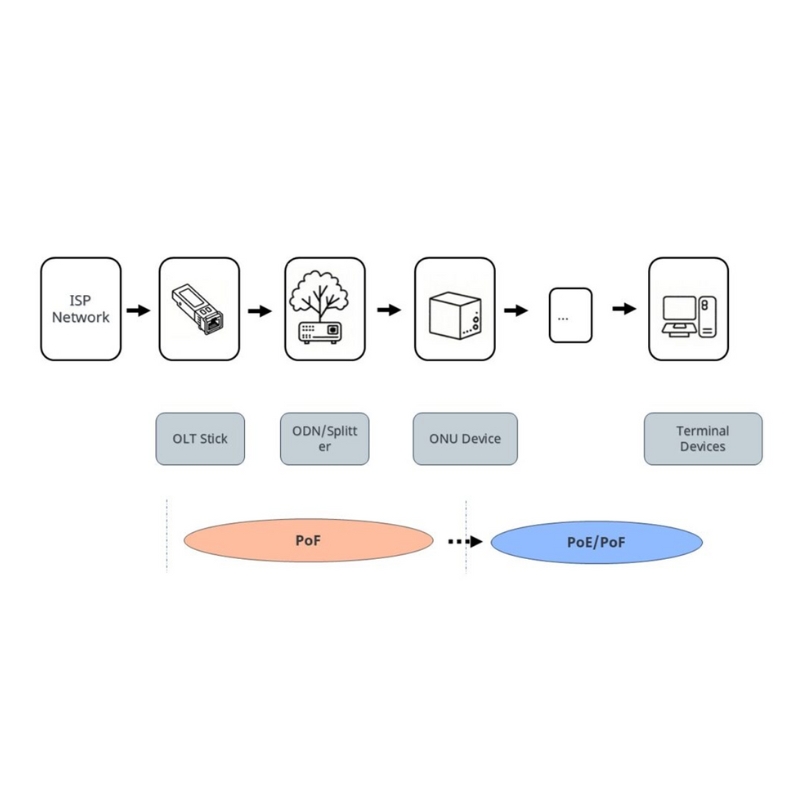
In the access segment from the ONU to endpoint devices, PoE remains the dominant solution. It delivers both data and power to APs, cameras, and similar endpoints with the lowest cost and operational complexity. In scenarios that span multiple rooms or floors, or where the distance to endpoints exceeds 100 meters, PoF (Power over Fiber) offers clear advantages in transmission distance and cabling flexibility.
In the ODN segment between the OLT and the ONU, the PON network itself remains passive. However, in outdoor deployments, locations with limited access to local power, or scenarios with strong requirements for centralized power supply, operators can use PoF (Power over Fiber, hybrid fiber cabling) to deliver both optical signals and electrical power to remote ONUs. This approach simplifies power architecture and improves overall network reliability.
Conclusion
In PON network deployments, the choice of power delivery is as important as the choice of transmission medium. PoE(Power over Ethernet) and PoF(Power over Fiber) are not competing or mutually exclusive approaches. Each addresses how endpoints are powered at different network layers and under different deployment conditions.
PoE, built on a mature IEEE standards framework, remains unmatched in the access segment from the ONU to endpoints. It offers simple deployment, broad device compatibility, and low operational cost. This makes it well suited for offices, indoor APs, and standard surveillance points within the “last 100 meters.” It is the most widely adopted and cost-effective power delivery method today.
PoF (Power over Fiber) targets engineering scenarios constrained by distance, environment, or power availability. By carrying both optical fiber and electrical power in a single cable, PoF overcomes the distance and environmental limitations of PoE. It is suitable for cross-floor and cross-building links, outdoor deployments, and locations where endpoints are far from switches. In PON networks, especially where utility power is unavailable or centralized power is required, PoF provides a practical, engineering-grade method to supply both optical connectivity and power to remote ONUs.
In practical network design, PoE serves endpoint access, while PoF (Power over Fiber), Power over Fiber, extends reach over longer distances. Together, they form a layered and complementary model that balances performance, deployment cost, operational complexity, and future scalability. By combining PoE and PoF appropriately, a PON network can achieve an optimal engineering balance across diverse deployment scenarios.
Contact Us:
Website: dtechtrading.com.np
Location: Mahalaxmisthan, Lalitpur
Phone no: 9851248419/ 9802088552