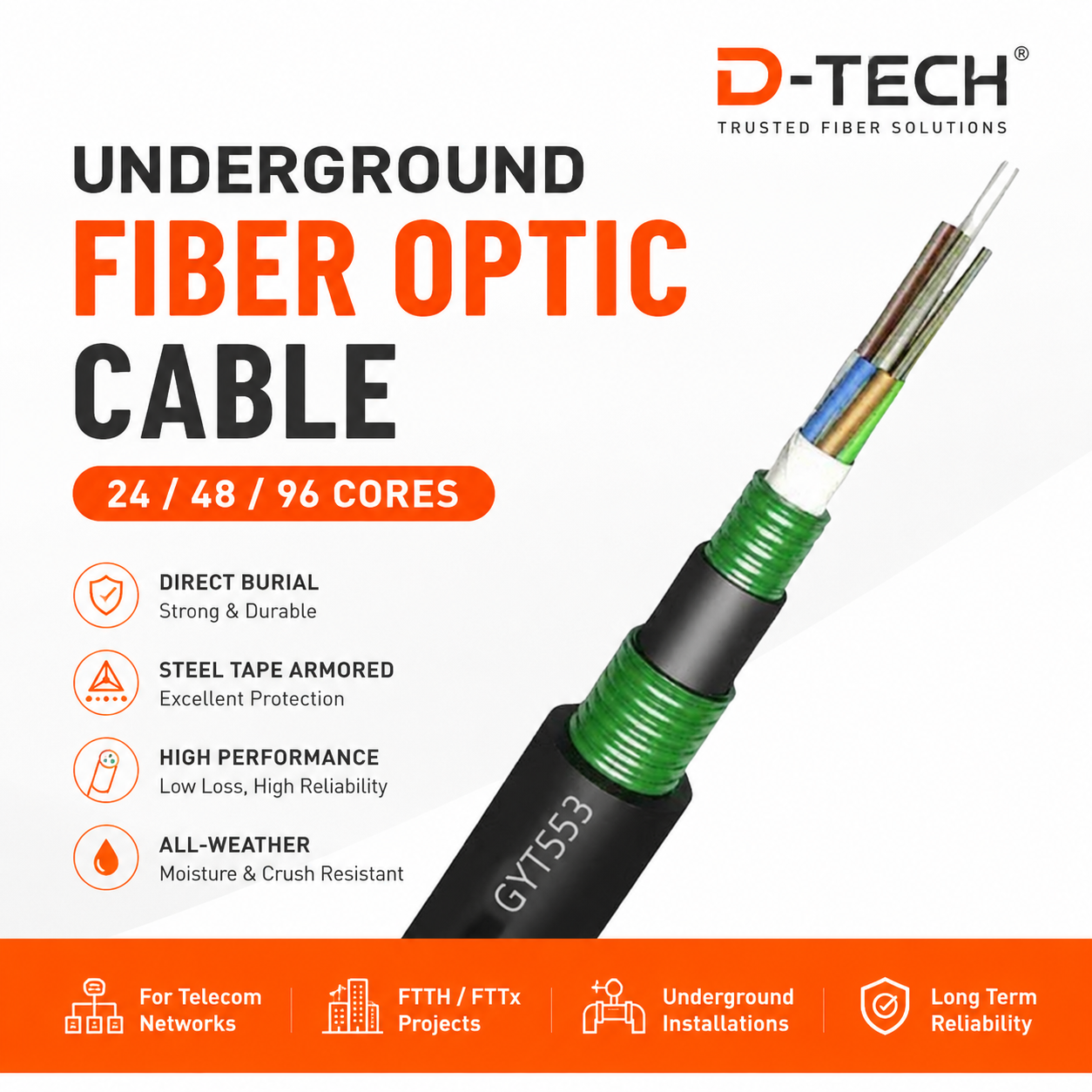
D-TECH Underground Fiber Solutions
Underground Optical Fiber Cable Solutions
Complete underground fiber optic cable, microduct, direct-burial, installation equipment and accessory solutions for reliable, long-term optical networks.
Complete Underground Network Support
Underground Fiber Optic Solutions from D-TECH
D-TECH provides complete solutions for underground optical fiber networks, including suitable fiber optic cables, ducts, accessories, installation equipment and technical guidance.
Aerial and underground fiber optic cables are not always constructed in the same way. Their mechanical protection, jacket construction, armor, water resistance, installation method and operating environment may be different. Therefore, the correct cable must be selected before installation.
Important
Aerial and Underground Cables Are Different
Aerial cables are designed to withstand overhead installation conditions, while underground cables are selected for ducts, conduits, trenches or direct-burial environments.
Long-Term Reliability
Select the Correct Cable for the Location
Correct cable selection helps protect the network from moisture, crushing pressure, pulling tension, soil conditions, rodents and other environmental risks.
Cable Selection
Types of Underground Optical Fiber Cable
Underground fiber networks can use different cable constructions depending on the duct system, installation route and project requirements.
Quick Comparison
Underground Fiber Cable Installation Methods
| Cable Solution | Installation Method | Duct Required | Main Benefit | Typical Use |
|---|---|---|---|---|
| Micro Fiber Cable | Air blown into microduct | Yes | Compact and expandable | Telecom and high-density networks |
| Standard Duct Cable | Pulled or blown through conduit | Yes | Added route protection | ISP, campus and backbone routes |
| Direct-Buried Armored Cable | Installed directly in a prepared trench | Not always | Strong mechanical protection | Routes without existing duct infrastructure |
Final cable selection should be based on route conditions, duct size, pulling distance, bend requirements, fiber count, mechanical load and the cable manufacturer’s installation specifications.
Installation Equipment
Underground Fiber Cable Accessories and Tools
The correct installation equipment helps technicians install underground fiber safely, efficiently and without exceeding the cable’s mechanical limits.
Fiber Air-Blowing Machine
Used to install compatible micro or standard fiber optic cable through a suitable duct using controlled airflow and cable-feeding force.
300 m Duct Rodder
Used for duct-route preparation, pulling ropes, checking conduit continuity and supporting cable-pulling work.
HDPE Duct and Microduct
Provides a protected pathway for fiber cable and supports easier maintenance, replacement and future network expansion.
Cable Pulling Accessories
Pulling ropes, swivels, cable grips, lubricants and rollers may be required depending on the cable and route design.
Fiber Joint Closure
Protects fiber splices and cable joints from moisture, dirt and environmental exposure in underground networks.
Handhole and Manhole Accessories
Supports cable access, joint protection, storage and maintenance at selected points along the underground route.
Planning Guide
How to Select Underground Fiber Optic Cable
Network Applications
Applications of Underground Fiber Networks
ISP Backbone Networks
Underground routes between network nodes, exchanges and service areas.
FTTH and FTTx Networks
Optical distribution routes for residential and commercial access networks.
Campus Networks
Fiber connectivity between buildings in schools, hospitals and institutions.
Hydropower Projects
Communication and monitoring networks across project facilities.
Industrial Networks
Reliable fiber routes for factories, warehouses and production facilities.
CCTV Fiber Networks
Long-distance optical connectivity for security and surveillance systems.
Government Infrastructure
Fiber networks for municipalities, public institutions and smart-city projects.
Data Center Connectivity
Protected external links between facilities and network infrastructure.
Complete Fiber Optic Support
Why Choose D-TECH?
D-TECH helps customers select the correct underground optical fiber cable based on the project route, duct system, fiber count, installation method and environmental conditions.
We also provide related accessories, installation tools, fiber testing equipment and technical support for complete optical fiber network projects.
Common Questions
Frequently Asked Questions
What is underground optical fiber cable?
Underground optical fiber cable is an outdoor cable selected for installation inside a duct, microduct, conduit or directly in a prepared underground route.
Can aerial fiber cable be used underground?
A cable should only be used in an underground environment when its construction and manufacturer specifications permit that installation. Aerial and underground installation requirements can be different.
What is micro fiber cable?
Micro fiber cable is a compact optical cable designed for installation inside a compatible microduct, commonly using an air-blowing machine.
Does underground fiber cable always require a duct?
No. Duct and microduct cables require a suitable conduit system, while cables specifically designed and approved for direct burial may be installed in a prepared underground route without a separate duct.
What equipment is used for air-blown fiber installation?
A compatible fiber air-blowing machine, air compressor, duct, cable-feeding accessories and route-preparation tools are typically required.
Where can I get underground fiber solutions in Nepal?
D-TECH provides underground optical fiber cables, microduct solutions, armored cables, duct rodders, air-blowing equipment, accessories and technical support in Nepal.