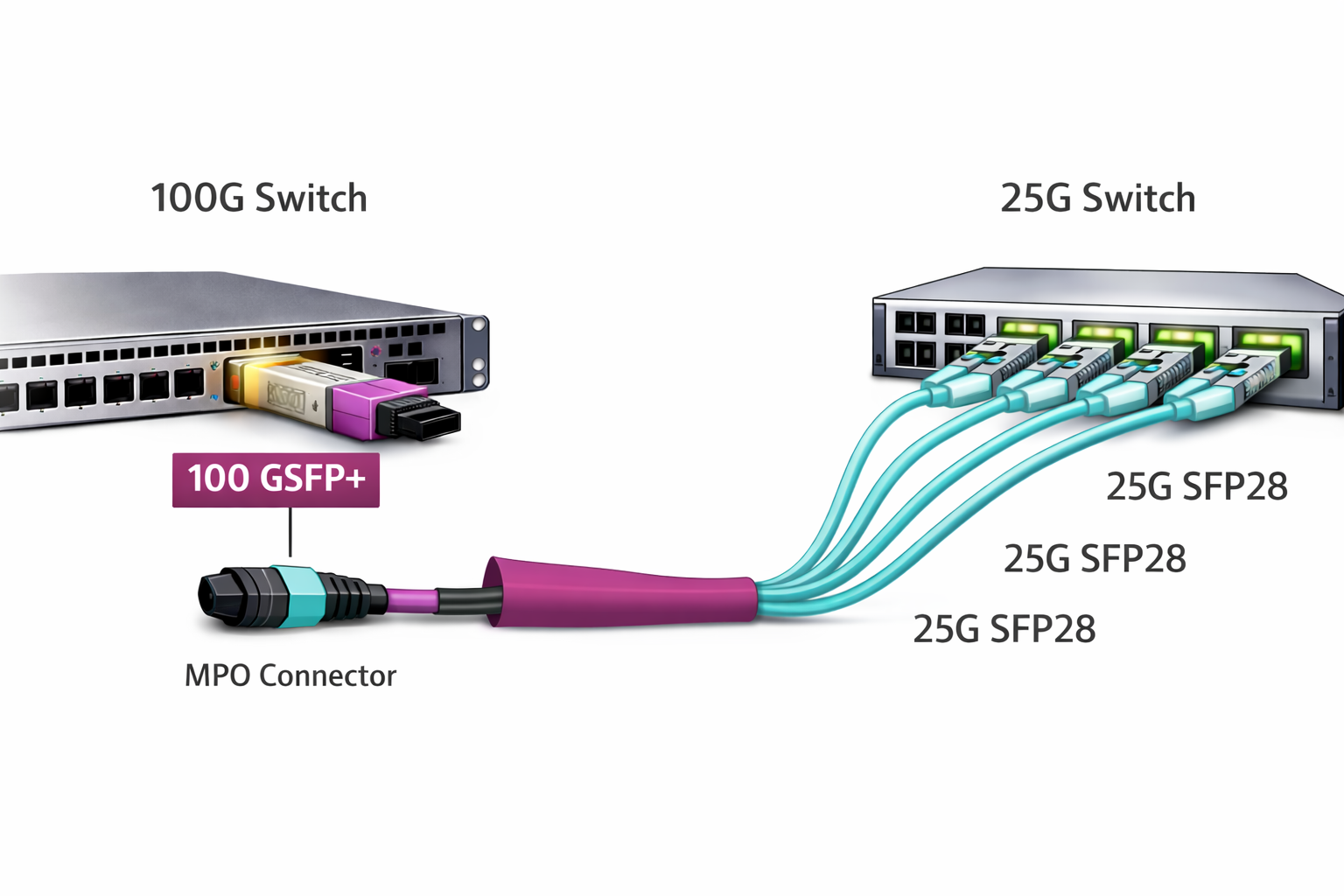
Basic Concept of Breakout Cable
A breakout cable is used to split one high-speed network port into multiple lower-speed connections.
This allows a single high-capacity port to connect to several devices at the same time.
Example
High-Speed Port | Breakout Result |
40G QSFP+ | 4 × 10G links |
100G QSFP28 | 4 × 25G links |
400G QSFP-DD | 8 × 50G links |
Instead of creating only one high-speed connection, breakout cables allow multiple independent connections from the same port.
Why Breakout Cables Exist
Modern network switches often provide very high-speed ports, such as 40G, 100G, or 400G.
However, many connected devices—such as servers, access switches, or storage systems—may operate at lower speeds.
Breakout cables solve this mismatch by allowing the high-speed port to be divided into several smaller connections.
Example Scenario
Device | Port Speed |
Core switch | 100G |
Server | 25G |
Using a breakout cable:
1 × 100G port → 4 × 25G connections


Visit our product: Breakout MPO Cable to LC