D-TECH Fusion Splicer Guide
Difference Between Core Alignment and Cladding Alignment Fusion Splicers
Understand how these two fiber-alignment technologies differ in accuracy, splice performance, applications, machine design and price.
Quick Explanation
What Is the Main Difference?
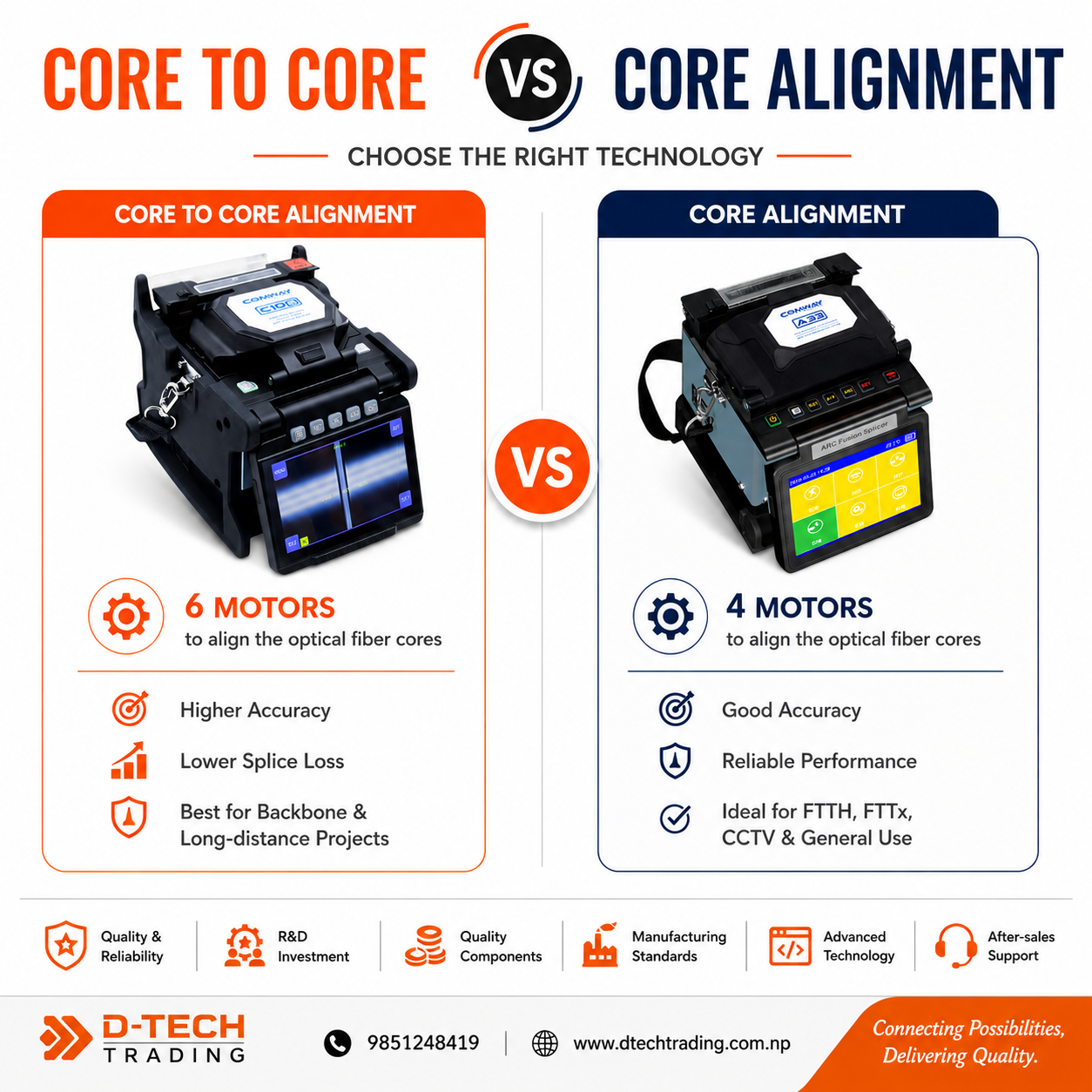
A core alignment fusion splicer detects and aligns the actual optical fiber cores before fusion. This provides excellent precision and is preferred for backbone, long-distance and other low-loss fiber networks.
A cladding alignment fusion splicer aligns the fibers mainly by their outer cladding position. It provides dependable performance for standard FTTH, FTTx, CCTV and routine field installations.
Alignment Technologies
Core Alignment vs Cladding Alignment
Quick Comparison
Fusion Splicer Alignment Comparison
| Feature | Core Alignment | Cladding Alignment |
|---|---|---|
| Alignment Method | Aligns the optical fiber cores | Aligns the outer fiber cladding |
| Splicing Precision | Higher precision | Good standard performance |
| Typical Splice Loss | Generally lower and more stable | Suitable for standard field installation |
| Best Applications | Backbone, long-distance, enterprise and professional networks | FTTH, FTTx, CCTV, access networks and maintenance |
| Machine Category | Professional or premium | Practical and field-friendly |
| Relative Cost | Generally higher | Generally more affordable |
Recommended Use
Which Fusion Splicer Should You Choose?
Choose Core Alignment When:
- Very low splice loss is important
- You are working on backbone fiber networks
- The project uses long-distance transmission
- Network performance and stability are priorities
- You need a professional-grade fusion splicing solution
Choose Cladding Alignment When:
- You are completing standard FTTH installations
- The machine is needed for regular field work
- You work with CCTV or smaller access networks
- Portability and affordability are important
- You need dependable performance for daily maintenance
Price and Quality
Why Are Fusion Splicer Prices Different?
Fusion splicer prices vary because manufacturers use different alignment technologies, materials, software, quality-control standards and support systems.
Brand Reputation
Established brands may charge more for reliability, experience and market trust.
Research & Development
Advanced imaging, alignment and splice-control technologies require significant engineering.
Component Quality
The quality of motors, cameras, lenses, electrodes, batteries and circuit boards affects the price.
Splicing Software
More advanced software can improve fiber detection, arc control and splice consistency.
Durability
Field-ready construction, protection and long-term reliability can increase manufacturing cost.
After-Sales Support
Warranty, technical assistance, spare parts and service availability also influence value.
Price Comparison
Which Fusion Splicer Usually Costs More?
Core alignment fusion splicers are generally more expensive because they use more advanced core-detection and positioning technology. Cladding alignment models are usually more economical and are suitable for many standard installation and maintenance projects.
Professional Fiber Equipment Support
Why Choose D-TECH?
D-TECH has worked with optical fiber equipment since 2014. Our team supports fusion splicers, OTDRs, optical power meters and other fiber testing equipment for ISP, FTTH, telecom and networking projects.
We help customers compare technologies, select suitable equipment and receive professional technical and after-sales support.
Common Questions
Frequently Asked Questions
What is a core alignment fusion splicer?
A core alignment fusion splicer detects and aligns the optical fiber cores before fusion to help achieve precise and stable splices.
What is a cladding alignment fusion splicer?
A cladding alignment fusion splicer positions the fibers mainly by aligning their outer cladding surfaces before splicing.
Which fusion splicer is better for backbone networks?
Core alignment is normally preferred for backbone and long-distance networks where low splice loss and high stability are important.
Which fusion splicer is suitable for FTTH?
Both technologies can be used for FTTH. Cladding alignment is commonly selected for standard installations, while core alignment may be chosen where greater precision is required.
Is a six-motor splicer always a core alignment machine?
Motor count alone should not be used to identify the alignment technology. Check whether the manufacturer officially describes the machine as core alignment, cladding alignment or another alignment system.